
When engineers search for Micro Motion vs Promass vs Rotamass, they are usually not looking for another generic Coriolis flow meter brochure. They want to know which meter delivers the best accuracy, reliability, and lifecycle value for their specific application.
The short answer is straightforward:
The challenge is that all three manufacturers claim excellent performance, making selection difficult for procurement teams and plant engineers. This guide compares their actual strengths, limitations, and ideal application scenarios based on real-world industrial requirements.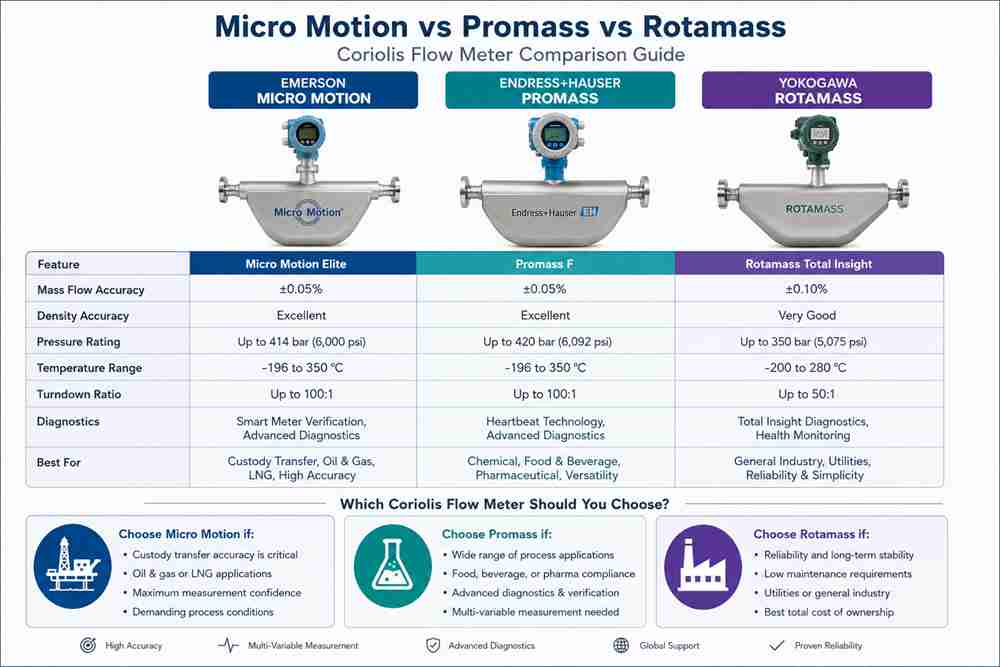
A Coriolis flow meter is often installed in critical process points where measurement errors directly affect production efficiency, product quality, and revenue.
Typical consequences of incorrect meter selection include:
For plants operating 24/7, even a small measurement deviation can translate into significant annual losses.
That is why many engineers compare Micro Motion, Promass, and Rotamass before making a purchasing decision.
| Parameter | Micro Motion Elite | Promass F | Rotamass Total Insight |
|---|---|---|---|
| Mass Flow Accuracy | ±0.05% | ±0.05% | ±0.10% |
| Density Accuracy | Excellent | Excellent | Very Good |
| Repeatability | Outstanding | Outstanding | Excellent |
| Custody Transfer Approval | Extensive | Extensive | Available |
For applications involving:
Micro Motion and Promass generally provide the highest measurement confidence.
Rotamass remains highly accurate but is typically selected when operational simplicity and long-term reliability are prioritized over achieving the absolute highest accuracy specification.
Modern Coriolis flow meters frequently operate under demanding process conditions.
| Parameter | Micro Motion | Promass | Rotamass |
|---|---|---|---|
| High Pressure Service | Excellent | Excellent | Very Good |
| High Temperature Service | Excellent | Excellent | Good |
| Cryogenic Applications | Excellent | Excellent | Good |
| Chemical Compatibility | Excellent | Excellent | Excellent |
For LNG, hydrogen, and cryogenic services, Micro Motion and Promass typically offer broader documented application experience.
When production accounting or custody transfer accuracy is critical, Micro Motion is often considered the industry benchmark.
Common applications include:
Many EPC contractors specify Micro Motion directly because of its extensive installed base worldwide.
Promass has built a strong reputation in chemical plants due to its wide range of process connections, diagnostics, and integrated multi-variable measurement functions.
Common applications:
Promass is particularly attractive when operators want a single device measuring:
simultaneously.
In hygienic applications, Promass frequently becomes the preferred option.
Reasons include:
Typical installations include:
Rotamass performs extremely well in:
Many users appreciate its straightforward operation and low maintenance requirements.
One of the biggest differences among leading Coriolis flow meter brands today is diagnostic intelligence.
Features include:
Features include:
Features include:
For facilities moving toward Industry 4.0 initiatives, all three platforms provide substantial diagnostic capabilities.
The purchase price is only one part of the equation.
Experienced engineers often evaluate:
A lower initial purchase price does not necessarily translate into a lower total ownership cost over ten years of operation.
In many cases, the most economical choice depends on local support availability and process requirements rather than equipment price alone.
The answer depends on your process objectives.
Technical Note: Beyond flow measurement, balancing long-term process stability also requires integrating reliable robust Pressure Transmitters and accurate Level Meters into your control loops.
The debate between Micro Motion vs Promass vs Rotamass does not have a universal winner.
Each platform has proven itself in thousands of industrial installations worldwide, but their strengths differ significantly.
Micro Motion leads in demanding custody transfer and hydrocarbon applications. Promass excels in versatility and advanced diagnostics across multiple industries. Rotamass offers dependable performance with a strong focus on operational simplicity and lifecycle value.
Rather than asking which Coriolis flow meter is best overall, the better question is:
Navigating between Emerson, Endress+Hauser, and Yokogawa can be complex. As a dedicated industrial instrumentation partner, we simplify your sourcing project by offering genuine sourcing, comprehensive technical cross-referencing, and flexible supply chain support.
Discover Why Global Engineers Choose Us →Both Emerson Micro Motion Elite and Endress+Hauser Promass F offer mass flow accuracy up to ±0.05% under standard reference conditions. In real-world applications, the better choice depends on process conditions, installation quality, calibration requirements, and long-term maintenance strategy rather than specification alone.
Certain Yokogawa Rotamass models can be used in custody transfer applications when they meet local regulatory and certification requirements. However, Micro Motion and Promass generally have broader global adoption in high-value fiscal metering projects such as oil, LNG, and refined products.
Endress+Hauser Promass is widely selected for chemical processing because of its broad product portfolio, multi-variable measurement capabilities, and compatibility with corrosive media. The optimal choice still depends on fluid properties, operating pressure, temperature, and required certifications.
The primary differences are application focus and feature sets.
All three manufacturers provide advanced diagnostics.
The most suitable diagnostic platform depends on the plant's maintenance strategy and digital asset management system.
Yes. Modern Coriolis flow meters from Micro Motion, Promass, and Rotamass can simultaneously measure mass flow, density, and process temperature. This enables a single instrument to provide multiple process variables for improved control and monitoring.
Micro Motion and Promass are commonly specified for LNG applications because of their high accuracy, cryogenic performance, and extensive industry experience. Final selection should also consider pressure rating, material compatibility, and project specifications.
Start by evaluating:
To find the right instrument for your plant, you can browse our full technical inventory of high-performance


